Pinoy inventor jumpstarts monthly innovation forum
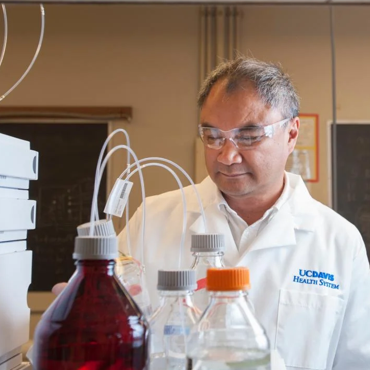
Filipino biochemist and entrepreneur Dr. Carlito Lebrilla in his element. (Photo credit: Gregory Urquiaga, UCDavis)
Inventors revolutionize the world because they often see in a different light—sometimes literally so, as in the case of this Filipino scientist-entrepreneur.
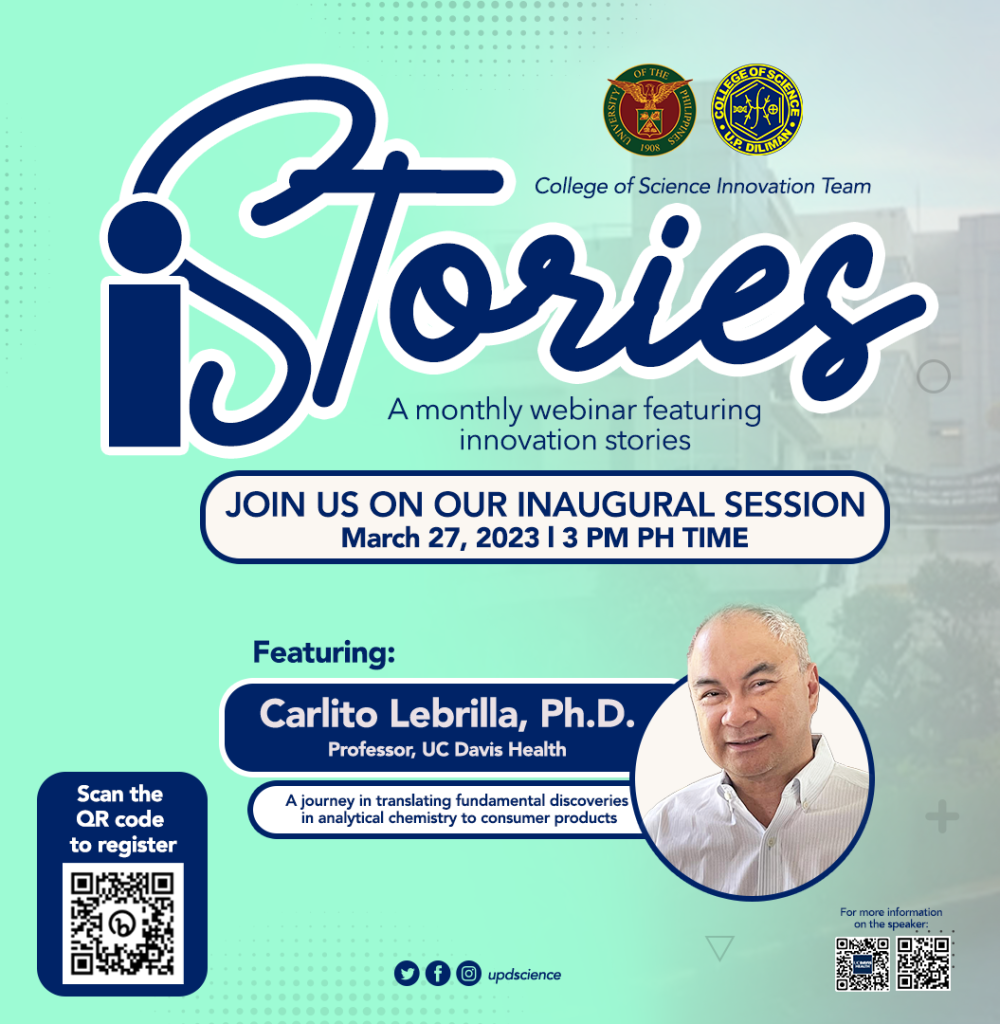
A distinguished professor and biochemist, Dr. Carlito Lebrilla of the University of California, Davis (UC Davis) is also a corresponding member of the National Academy of Science and Technology (NAST). He will be highlighting his research on mass spectrometry and the fundamentals of innovation for startup companies at the free inaugural iStories webinar hosted by the University of the Philippines Diliman College of Science (UPD-CS) this coming March 27.
A business born from mass spectrometry
Dr. Lebrilla’s research is focused on understanding fundamental processes in the ionization, fragmentation, and detection of ions. This enabled him to build a complex Fourier transform ion cyclotron resonance (FTICR) mass spectrometer that marked the start of a research and teaching career centered on mass spectrometry.
Mass spectrometry is an analytical technique used to identify and quantify compounds, and determine structure and chemical properties of molecules via molecular weight determination. Chemists can use a mass spectrometer to ionize a molecular compound in gaseous form, sort the fragments, and then identify the molecule fragments based on their molecular weights. Applications of mass spectrometry include determination of rock ages, biochemical evolution of the Earth, and space explorations.
In Dr. Lebrilla’s case, his work on mass spectrometry helped him transition into the biomedical field that led him to develop methods for characterizing glycoconjugates—the biochemicals that contain carbohydrates bonded to some other compounds such as protein and lipid—in cells, animals, and humans.
Dr. Lebrilla’s further research and discoveries in mass spectrometry have led to several patents and the founding of at least five companies. “I realized there were so many problems that mass spectrometry can solve in food, in health, and even in basic fundamental biological issues. I just kept finding new ideas there, which really appealed to me,” he says in one interview with Journal of the American Society for Mass Spectronomy.